

Choosing the right HDPE pipe is an important decision for any water supply, irrigation, construction, or industrial project. The correct pipe can help ensure dependable fluid transportation, efficient installation, and long-term system performance. However, selecting a pipe based only on its diameter or price can lead to problems when the product does not match the actual project requirements.
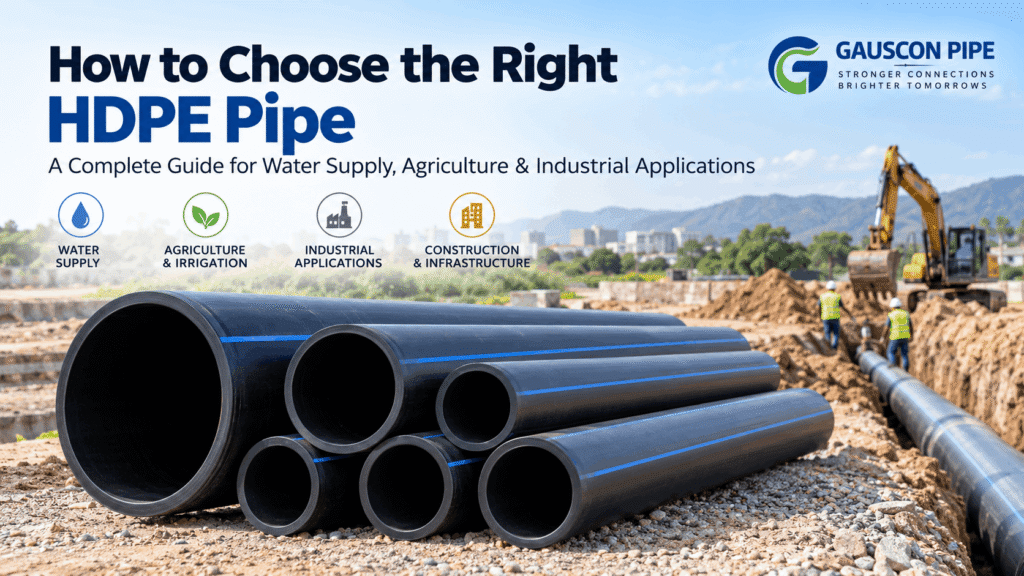
HDPE pipes are available in different sizes, material grades, wall thicknesses, and pressure ratings. The best option depends on several factors, including the intended application, operating pressure, flow requirements, installation environment, and applicable technical standards.
In this guide, we explain how to choose the right HDPE pipe and the key specifications to consider before placing an order.
What Is an HDPE Pipe?
HDPE stands for High-Density Polyethylene. HDPE pipes are manufactured from polyethylene materials and are widely used for applications such as water distribution, irrigation, drainage, industrial fluid transportation, and infrastructure systems.
One of the major advantages of HDPE piping is its combination of strength, flexibility, and resistance to corrosion. Depending on the material grade and design, HDPE pipes can be suitable for demanding installations, including underground pipelines and systems that require flexible routing.
HDPE pipes can be joined using methods such as butt fusion, electrofusion, and suitable mechanical fittings. The appropriate jointing method depends on the pipe specification, fittings, and project requirements.
The important point is that not every HDPE pipe is suitable for every application. Selecting the right specification is essential for reliable performance.
Why Is Choosing the Right HDPE Pipe Important?
A pipeline is only as reliable as the compatibility between its design and the pipe selected. An unsuitable pipe may create installation difficulties, increase operating costs, or fail to perform as expected under actual service conditions.
Choosing the correct HDPE pipe helps you:
- Match the pipe to the required operating pressure.
- Transport the required flow of water or other compatible fluids.
- Reduce unnecessary material and installation costs.
- Select an appropriate diameter and wall thickness.
- Improve compatibility with fittings and jointing equipment.
- Meet project specifications and relevant standards.
- Support long-term performance in the intended environment.
Whether you are developing an agricultural irrigation system, a water distribution network, or an industrial pipeline, careful selection should happen before procurement.
7 Important Factors to Consider When Choosing an HDPE Pipe
1. Identify the Application
The first step in selecting the right HDPE pipe is understanding where and how it will be used.
Different applications may have different requirements for pressure, diameter, material compatibility, installation, and regulatory compliance.
HDPE pipes for water supply
Water supply systems may include municipal distribution networks, rural water schemes, building services, and other infrastructure projects. The selected pipe should be suitable for the intended water service, operating pressure, and applicable drinking-water or project requirements.
HDPE pipes for agriculture and irrigation
Agricultural projects may use HDPE pipes to transport water from a source to fields, storage tanks, pumps, or irrigation equipment. The selection should account for the required flow, pump conditions, pressure, and whether the pipeline will be installed underground or exposed.
HDPE pipes for industrial applications
Industrial systems may transport water, process fluids, or other compatible substances. In addition to pressure and temperature, the chemical compatibility of the pipe material with the conveyed fluid must be verified.
HDPE pipes for construction and infrastructure
Construction and infrastructure projects may require piping for utility networks, drainage-related systems, protective ducts, or other specified uses. The relevant project specification should determine the material, dimensions, and performance requirements.
Practical tip: Tell your pipe supplier the exact application before asking for a quotation. “HDPE pipe” alone is not a complete technical specification.
2. Determine the Required Pipe Diameter
Pipe diameter is one of the most important factors affecting the performance of a pipeline.
A pipe that is too small may create excessive friction losses and restrict the required flow. A pipe that is unnecessarily large may increase material, transportation, and installation costs.
To select the appropriate diameter, consider:
- Required flow rate.
- Pipeline length.
- Available pressure or pump head.
- Permissible head loss.
- Number of bends, valves, and fittings.
- Elevation changes along the route.
- Future expansion requirements.
For water systems, hydraulic calculations can help determine the appropriate internal flow area and expected pressure losses.
HDPE water pipes are commonly specified by their outside diameter (OD), usually in millimetres. The actual internal diameter depends on the outside diameter and wall thickness.
For example, two pipes with the same outside diameter may have different internal diameters if their wall thicknesses differ.
Important: Do not select a pipe size based only on the outside diameter. Confirm the wall thickness, internal diameter, and hydraulic requirements.
3. Check the Operating Pressure and Pressure Rating
Pressure rating is critical when selecting HDPE pipes for pumped water supply, irrigation, borewell systems, and industrial pipelines.
The pressure rating indicates the pressure conditions for which a pipe is designed under specified conditions. In many water-pipe specifications, pressure classes are expressed using PN, such as PN 6, PN 10, or PN 16.
The selected rating should account for the actual system conditions, including:
- Normal operating pressure.
- Maximum pump discharge pressure.
- Static pressure caused by elevation.
- Pressure surges and water hammer.
- Temperature effects.
- Installation and service conditions.
- The applicable design standard.
For example, a pipeline supplied by a pump may experience pressure fluctuations when the pump starts or stops, or when valves close rapidly. These conditions should be evaluated during pipeline design.
Do not choose a PN rating solely because it is the highest available or the least expensive. The correct selection should be based on an engineering assessment of the complete system.
For larger or more complex projects, a qualified pipeline engineer should confirm the design pressure and required pressure class.
4. Understand SDR and Wall Thickness
SDR is an important term when buying HDPE pipes.
SDR stands for Standard Dimension Ratio. It is calculated as:
SDR = Outside Diameter ÷ Minimum Wall Thickness
For example, if a pipe has an outside diameter of 110 mm and a minimum wall thickness of 10 mm:
SDR = 110 ÷ 10 = 11
The pipe would have an SDR of 11.
In general, for a given material grade and applicable standard:
- A lower SDR means a thicker pipe wall.
- A thicker wall generally corresponds to a higher pressure capability.
- A higher SDR means a thinner pipe wall.
- The pressure rating depends on the material grade, SDR, design conditions, and standard.
For example, an SDR 11 pipe generally has a thicker wall than an SDR 17 pipe of the same outside diameter.
However, SDR and PN should not be treated as interchangeable labels without checking the material grade and applicable standard. The same SDR may correspond to different pressure ratings for different polyethylene grades.
Before purchasing, confirm:
- Outside diameter.
- Minimum wall thickness.
- SDR.
- Material grade.
- Pressure class.
- Applicable product standard.
This helps avoid ordering a pipe that looks correct but does not meet the project’s pressure requirements.
5. Select the Appropriate Material Grade: PE80 or PE100
HDPE pipes can be manufactured using different polyethylene material grades, including PE80 and PE100.
The material grade is an important part of the pipe specification because it influences the material’s design strength and the pressure capability that can be assigned under the relevant standard.
PE80
PE80 is a polyethylene classification used in pipe systems. It may be appropriate for applications where its material properties and the specified design requirements are suitable.
PE100
PE100 is a higher-design-strength polyethylene classification commonly used in modern pressure-pipe systems. It can offer design advantages when the relevant standard and application permit its use.
The choice between PE80 and PE100 should not be based on the name alone. Consider:
- Required pressure rating.
- Pipe diameter and wall thickness.
- Applicable standard.
- Temperature and service conditions.
- Availability of compatible fittings.
- Project specifications.
- Total installed cost.
A higher material grade does not automatically mean that every PE100 pipe is suitable for every project. The complete pipe specification must still be verified.
6. Check the Applicable Quality Standards
Quality standards help define the requirements for pipe materials, dimensions, manufacturing, testing, and performance.
For water supply projects in India, IS 4984:2016 is an important standard to review when it applies to the specified HDPE water pipe. Other applications may require different standards or project-specific specifications.
Depending on the intended use, you should verify:
- The applicable Indian Standard or international standard.
- Material classification.
- Dimensions and tolerances.
- Pressure rating.
- Hydrostatic performance requirements.
- Marking and traceability.
- Required factory and product tests.
- Any applicable certification or compliance documentation.
Do not assume that a pipe is suitable simply because it is labelled “HDPE” or “heavy duty.” Ask the manufacturer or supplier for the technical documentation relevant to your project.
For government, municipal, or large industrial projects, always follow the tender documents and engineer-approved specifications.
7. Consider Installation Conditions and Jointing
The installation environment can influence the type of pipe and fittings you need.
Before finalizing your selection, consider whether the pipe will be:
- Installed underground.
- Installed above ground.
- Laid across uneven terrain.
- Routed around obstacles.
- Exposed to sunlight.
- Subjected to traffic or external loads.
- Installed in a location with difficult access.
HDPE pipes are known for their flexibility, which can be helpful in installations involving curves and changing terrain. Nevertheless, the pipe must be installed according to the relevant installation requirements.
Jointing methods
Common HDPE pipe jointing methods include:
Butt fusion: The ends of compatible thermoplastic pipes or fittings are heated and joined under controlled conditions.
Electrofusion: Special fittings with embedded electrical heating elements are used to join compatible pipe components.
Mechanical fittings: Mechanical connections may be used where the system design, pipe specification, and fitting compatibility permit them.
The jointing method should be selected based on pipe dimensions, SDR, material compatibility, equipment, site conditions, and the installation procedure.
A reliable pipe system requires not only a suitable pipe but also correctly selected fittings and properly executed joints.
How to Choose the Right HDPE Pipe: A Simple Selection Process
Use the following process when preparing your project specification.
Step 1: Define the purpose
Identify whether the pipeline is for water supply, irrigation, drainage, industrial service, or another approved application.
Step 2: Calculate the required flow
Determine the required flow rate and consider pipeline length, elevation, fittings, and acceptable head loss.
Step 3: Establish the pressure requirements
Calculate the expected operating pressure and consider pressure surges, temperature, and other design conditions.
Step 4: Select the diameter
Choose a suitable outside diameter and verify the resulting internal diameter and hydraulic performance.
Step 5: Select material grade and SDR
Choose a suitable PE grade, wall thickness, and SDR based on the required pressure class and applicable standard.
Step 6: Confirm standards and documentation
Verify the required product standard, test requirements, markings, and compliance documents.
Step 7: Review installation and fittings
Confirm jointing methods, fittings, installation conditions, and any project-specific requirements.
Step 8: Compare suppliers
Evaluate technical compliance, product quality, manufacturing consistency, delivery capability, and overall value—not just the quoted price.
Common Mistakes to Avoid When Buying HDPE Pipes
Choosing the pipe based only on price
The cheapest quotation may not represent the lowest total project cost. Consider product quality, installation requirements, service performance, and compliance with the specification.
Selecting a pressure rating without checking the system
A pipe should be selected for the actual design conditions, including pressure surges and temperature effects where applicable.
Confusing SDR with pressure rating
SDR describes the relationship between outside diameter and wall thickness. Pressure rating also depends on material grade and design standard.
Ignoring the installation environment
Underground and above-ground installations may have different requirements. External loads, sunlight, temperature, and support conditions should be considered.
Not checking fittings and joint compatibility
The pipe, fittings, and jointing method should be compatible. Mixing unsuitable dimensions or specifications can create installation problems.
Buying without technical documentation
Always request the relevant product specifications and compliance information before placing an order, especially for major infrastructure projects.
Why Choose Gauscon Pipe for Your HDPE Pipe Requirements?
Selecting the right manufacturer is an important part of a successful piping project. Gauscon Pipe provides HDPE pipe solutions for applications such as water supply, industrial systems, construction, and other infrastructure requirements.
When discussing your requirements with Gauscon Pipe, provide the project details needed to identify a suitable product specification, including:
- Application and intended service.
- Required pipe diameter.
- Operating pressure and pressure class.
- Material grade and SDR, if specified.
- Project quantity and required lengths.
- Installation conditions.
- Applicable standards and documentation.
- Delivery location and project schedule.
Gauscon Pipe can help you evaluate the available product options and identify a pipe solution that aligns with your project requirements.
Frequently Asked Questions About Choosing HDPE Pipes
Which HDPE pipe is best for water supply?
The best HDPE pipe for water supply is one that matches the required diameter, operating pressure, material grade, wall thickness, and applicable water-pipe standard. The correct selection depends on the specific water distribution system.
How do I select the correct HDPE pipe size?
Start with the required flow rate, pipeline length, available pressure, elevation changes, and acceptable head loss. Use hydraulic calculations to select an appropriate outside diameter and verify the internal diameter.
What is the difference between PE80 and PE100?
PE80 and PE100 are polyethylene material classifications used in pipe systems. They have different design-strength classifications. The appropriate grade depends on the applicable standard, pressure requirements, temperature, and project specification.
Is a lower SDR better for HDPE pipes?
A lower SDR generally means a thicker wall for the same outside diameter. It may provide a higher pressure capability under the relevant standard, but it is not automatically the best choice for every project. The required SDR should be determined from the design conditions.
Can HDPE pipes be used for agricultural irrigation?
Yes. HDPE pipes can be used in agricultural irrigation systems when the selected pipe is suitable for the required flow, pressure, installation environment, and irrigation application.
How long do HDPE pipes last?
HDPE pipe service life depends on material quality, design, operating conditions, temperature, installation, and maintenance. A reliable service-life estimate should be based on the applicable design standard and the actual project conditions.
What information should I give an HDPE pipe manufacturer?
Provide the intended application, required diameter, flow rate, operating pressure, material or SDR specification if known, quantity, installation conditions, applicable standards, and delivery requirements.
Final Thoughts
Choosing the right HDPE pipe is about more than selecting a diameter or comparing prices. A dependable piping solution requires the correct application, size, pressure rating, material grade, wall thickness, standards, and installation approach.
By reviewing these factors before purchasing, project owners, contractors, engineers, and procurement teams can make more informed decisions and reduce the risk of specification or installation problems.
If you are planning a water supply, irrigation, industrial, or infrastructure project, start by defining your technical requirements and discuss them with a reliable HDPE pipe manufacturer.
Looking for the right HDPE pipe for your project? Contact Gauscon Pipe to discuss your requirements and explore suitable piping solutions.