

HDPE pipes have become a popular choice for water supply, agriculture, irrigation, industrial pipelines, underground infrastructure, electrical cable protection and several other applications. Their combination of durability, flexibility, corrosion resistance and long service life makes them suitable for demanding piping systems.
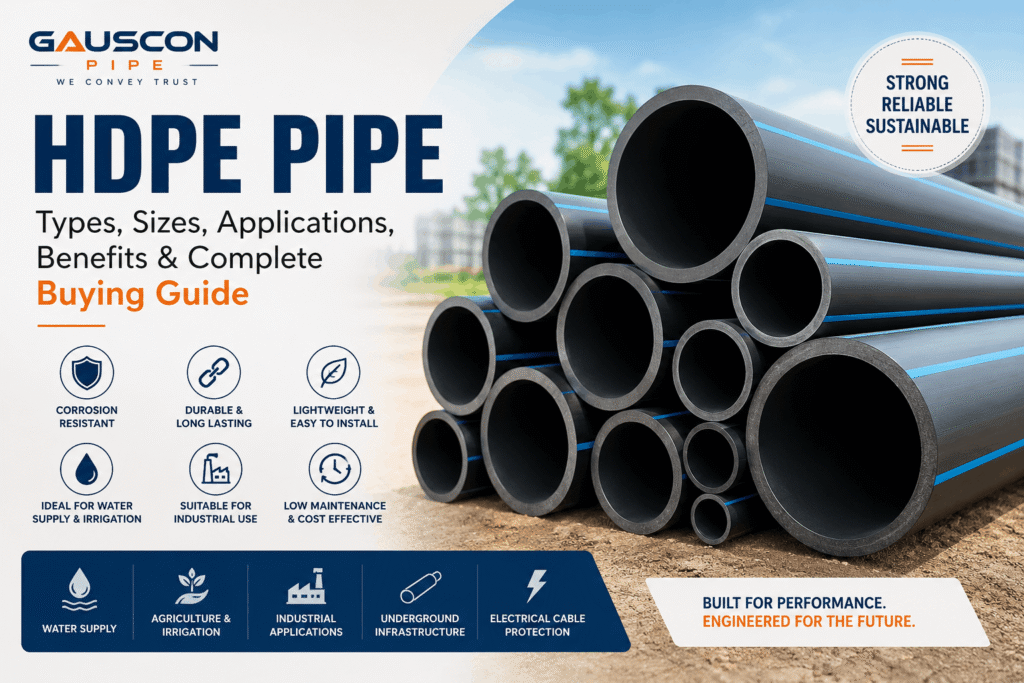
But with different HDPE pipe types, sizes, SDR classifications, pressure ratings and applications available, choosing the right pipe requires an understanding of the basic specifications.
In this guide, we explain what HDPE pipes are, their types, sizes, applications, benefits, pressure ratings and important factors to consider before buying.
What Is an HDPE Pipe?
HDPE stands for High-Density Polyethylene. HDPE pipes are manufactured using polyethylene material designed to provide strength, flexibility and resistance to corrosion and many chemicals.
HDPE piping systems are commonly used for transporting water, wastewater, irrigation fluids and other suitable materials. Depending on the product design and applicable standards, HDPE pipes are available in different diameters, wall thicknesses, SDR classifications and pressure ratings.
For projects where long-term performance and resistance to corrosion are important, HDPE pipes can provide an effective alternative to traditional piping materials.
Types of HDPE Pipes
HDPE pipes are available in different configurations depending on the application.
1. HDPE Water Pipes
HDPE water pipes are designed for water transportation and distribution systems.
Common applications include:
- Drinking water pipelines
- Municipal water supply
- Rural water distribution
- Industrial water systems
- Underground water pipelines
- Water treatment projects
2. HDPE Agricultural Pipes
HDPE pipes are widely used in agriculture and irrigation systems because they are lightweight, flexible and resistant to corrosion.
Applications include:
- Irrigation pipelines
- Agricultural water distribution
- Farm water systems
- Sprinkler irrigation
- Drip irrigation infrastructure
3. Industrial HDPE Pipes
Industrial HDPE pipes can be used in applications where resistance to corrosion, chemicals and harsh environmental conditions is required.
Potential applications include:
- Industrial water transportation
- Wastewater systems
- Process piping
- Chemical handling applications
- Mining and industrial infrastructure
The suitability of a particular HDPE pipe should always be evaluated against the material, temperature, pressure and chemical requirements of the application.
4. Underground HDPE Pipes
HDPE pipes are particularly suitable for underground installations because of their flexibility and resistance to corrosion.
They can be used for:
- Underground water pipelines
- Infrastructure projects
- Utility networks
- Irrigation systems
- Cable protection applications
5. HDPE Electrical Pipes and Cable Ducts
HDPE pipes can also be used to provide protection for electrical and communication cables.
Applications may include:
- Underground cable protection
- Electrical infrastructure
- Telecommunications
- Utility projects
6. HDPE Coil Pipes
HDPE coil pipes are supplied in long continuous lengths and can reduce the number of joints required in certain applications.
They can be useful for:
- Agricultural irrigation
- Water distribution
- Utility applications
- Long-distance pipeline installations
Common HDPE Pipe Sizes
HDPE pipes are manufactured in a wide range of diameters to meet different project requirements.
The appropriate size depends on factors such as:
- Required flow rate
- Operating pressure
- Pipeline length
- Application
- Installation conditions
- Required velocity
- Connection requirements
For example, smaller-diameter HDPE pipes may be suitable for certain irrigation or utility applications, while larger diameters can be required for municipal water supply and major infrastructure projects.
HDPE Pipe Size Selection
When selecting an HDPE pipe size, don’t consider diameter alone.
You should evaluate:
Diameter + Wall Thickness + SDR + Pressure Rating + Application
This combination provides a better understanding of whether a particular pipe is suitable for a project.
What Is SDR in HDPE Pipes?
SDR stands for Standard Dimension Ratio.
It represents the relationship between the outside diameter of a pipe and its wall thickness.
In simplified terms:
SDR = Outside Diameter ÷ Minimum Wall Thickness
A lower SDR generally means a thicker pipe wall relative to its diameter, while a higher SDR generally represents a thinner wall.
SDR is therefore an important specification when evaluating HDPE pipe pressure capability.
The appropriate SDR should be selected according to the project’s operating pressure, temperature, design requirements and applicable standards.
What Are PE80 and PE100 HDPE Pipes?
PE80 and PE100 refer to different classifications of polyethylene pipe materials.
PE100 generally offers a higher long-term strength classification than PE80, allowing appropriately designed pipes to achieve higher pressure capacity or use less material for a given pressure application.
However, choosing between PE80 and PE100 should not be based only on the material designation.
The complete pipe specification, applicable standard, pressure requirement, diameter, SDR and project conditions should be considered.
HDPE Pipe Pressure Rating
HDPE pipe pressure ratings are commonly associated with the pipe’s material grade, SDR and design requirements.
Pressure classifications may be expressed using PN ratings, depending on the applicable product standard.
When selecting a pressure-rated HDPE pipe, consider:
- Operating pressure
- Maximum expected pressure
- Temperature
- Surge pressure
- Pipe material
- SDR
- Installation conditions
- Applicable standards
For critical infrastructure projects, the manufacturer’s technical documentation should always be consulted before final selection.
Applications of HDPE Pipes
HDPE pipes are used across a wide range of industries.
Water Supply
One of the most common applications is the transportation and distribution of water.
HDPE pipes can be used for:
- Municipal water networks
- Rural water systems
- Industrial water supply
- Underground water pipelines
Agriculture and Irrigation
Agricultural applications can include:
- Irrigation pipelines
- Farm water distribution
- Sprinkler systems
- Drip irrigation infrastructure
Industrial Applications
Depending on the material and design specifications, HDPE piping systems can be used in:
- Industrial water systems
- Wastewater management
- Process applications
- Infrastructure projects
Underground Infrastructure
HDPE pipes can be used in underground networks where flexibility, corrosion resistance and long service life are important considerations.
Electrical and Telecommunications
HDPE ducts and pipes can provide physical protection for underground cables and utility infrastructure.
Benefits of HDPE Pipes
1. Corrosion Resistance
HDPE does not rust like conventional metal pipes, making it useful for many underground and water-related applications.
2. Flexibility
HDPE pipes can accommodate certain ground movements and changes in alignment better than rigid piping materials.
3. Long Service Life
When correctly designed, manufactured, installed and operated, HDPE piping systems can provide long-term service.
4. Lightweight
HDPE pipes are generally lighter than many traditional metallic piping alternatives, which can simplify handling and transportation.
5. Fewer Joints in Certain Installations
Long pipe lengths and coil configurations can reduce the number of joints required in some applications.
6. Fusion Jointing
HDPE systems can be joined using techniques such as butt fusion and electrofusion, depending on the pipe and project requirements.
Properly executed fusion joints can provide a continuous piping system.
7. Resistance to Many Chemicals
HDPE has good resistance to many chemicals, although compatibility should always be checked for the specific chemical, concentration and operating temperature.
8. Suitable for Underground Applications
Its flexibility and corrosion resistance make HDPE a popular option for many underground pipeline applications.
HDPE Pipe vs Traditional Metal Pipes
HDPE pipes offer several advantages compared with traditional metallic piping in applications where corrosion resistance, flexibility and weight are important.
| Feature | HDPE Pipe | Traditional Metal Pipe |
|---|---|---|
| Corrosion resistance | High | Depends on material/coating |
| Weight | Relatively lightweight | Generally heavier |
| Flexibility | High | Generally lower |
| Rust | Does not rust | Some metals can corrode |
| Jointing | Fusion/mechanical methods | Various joining methods |
| Underground use | Widely used | Application dependent |
| Chemical resistance | Good for many chemicals | Material dependent |
The best material depends on the project’s technical requirements rather than one material being universally better.
How to Choose the Right HDPE Pipe?
Before purchasing an HDPE pipe, evaluate the following factors.
1. Understand the Application
First determine whether the pipe will be used for:
- Water supply
- Agriculture
- Irrigation
- Industrial applications
- Underground utilities
- Electrical cable protection
- Wastewater
2. Determine the Required Diameter
Calculate the required flow capacity and select the appropriate pipe diameter.
3. Determine Operating Pressure
Understand the normal operating pressure as well as possible pressure surges.
4. Select the Appropriate SDR
Choose an SDR that meets the project’s pressure and design requirements.
5. Check Material Grade
Depending on the project, PE80 or PE100 may be specified.
6. Check Applicable Standards
Make sure the pipe complies with the required national or international standards for the intended application.
7. Consider Installation Conditions
Evaluate:
- Underground or above-ground installation
- Soil conditions
- Temperature
- Bending requirements
- Jointing method
- Accessibility
- Expected external loads
8. Verify Manufacturer Credentials
Before purchasing, check:
- Manufacturing capabilities
- Quality certifications
- Applicable product standards
- Testing procedures
- Technical documentation
- Product traceability
- Customer support
Why Choose a Reliable HDPE Pipe Manufacturer?
Choosing the correct manufacturer is just as important as selecting the correct pipe specification.
A reliable HDPE pipe manufacturer should provide clear information about:
- Product specifications
- Material grade
- Pipe dimensions
- SDR classification
- Pressure rating
- Applicable standards
- Quality-control procedures
- Testing
- Manufacturing capabilities
For large infrastructure and industrial projects, technical support and consistent product quality can be especially important.
HDPE Pipe Manufacturer in Kolkata
For businesses and infrastructure projects in Kolkata and West Bengal, working with a local HDPE pipe manufacturer can provide logistical and communication advantages.
Gauscon Pipe is a Kolkata-based manufacturer offering HDPE and MDPE piping solutions for applications including water supply, agriculture, industrial infrastructure, underground pipelines and electrical utility requirements.
The company provides different HDPE pipe solutions and technical specifications according to product and application requirements.
For project-specific requirements, buyers should discuss the required diameter, SDR, pressure rating, material grade, quantity and application with the manufacturer before placing an order.
Frequently Asked Questions About HDPE Pipes
What does HDPE stand for?
HDPE stands for High-Density Polyethylene, a polyethylene material widely used for manufacturing pipes and other products.
What are HDPE pipes used for?
HDPE pipes can be used for water supply, irrigation, agriculture, wastewater, industrial applications, underground infrastructure and electrical cable protection, depending on the pipe specification.
Are HDPE pipes suitable for underground applications?
Yes. HDPE pipes are widely used in underground applications because of their flexibility and corrosion resistance. The pipe should be designed and installed according to the specific project requirements.
What is PE100 in HDPE pipes?
PE100 is a polyethylene material classification associated with higher long-term strength compared with PE80. The final pressure capability depends on the complete pipe design, including SDR and applicable standards.
What is SDR in an HDPE pipe?
SDR, or Standard Dimension Ratio, is the ratio between the pipe’s outside diameter and minimum wall thickness. It is an important parameter when evaluating pipe pressure capability.
How do I choose an HDPE pipe size?
HDPE pipe size should be selected based on flow requirements, operating pressure, application, installation conditions and applicable design standards.
Are HDPE pipes good for agriculture?
HDPE pipes can be well suited to agricultural and irrigation applications because of their flexibility, corrosion resistance and durability. The appropriate pipe specification should be selected according to the irrigation system requirements.
How long do HDPE pipes last?
The service life depends on material quality, design, installation, operating conditions, temperature, pressure and environmental factors. Properly designed and installed HDPE systems can provide long-term service.
Conclusion
HDPE pipes are versatile piping solutions for water supply, agriculture, irrigation, industrial applications, underground infrastructure and utility projects.
However, choosing the right HDPE pipe requires more than simply selecting a diameter. Buyers should evaluate the application, material grade, SDR, pressure rating, dimensions, applicable standards and installation conditions.
For projects in Kolkata, West Bengal and other parts of India, selecting a manufacturer that can provide reliable technical specifications, quality documentation and application-specific support is essential.
If you are planning an HDPE piping project, contact Gauscon Pipe to discuss your required pipe diameter, application, pressure rating, quantity and project requirements.
Need an HDPE Pipe for your project? Get in touch with Gauscon Pipe for product specifications and a quotation.